Drivers and dynamics of Aedes albopictus expansion in 41 European countries: past reconstruction and future projections
Perlant C, Véber A, Paireau J, Tran-Kiem C, Kraemer MUG, Bosetti P, Cauchemez S.
HAL (2026)
Drivers and dynamics of Aedes albopictus expansion in 41 European countries: past reconstruction and future projections
Perlant C, Véber A, Paireau J, Tran-Kiem C, Kraemer MUG, Bosetti P, Cauchemez S.
HAL (2026)

Abstract
Background: Aedes albopictus is a highly invasive mosquito and a competent vector of dengue, chikungunya, and Zika viruses. Since its introduction into Europe in 1979, it has expanded across large parts of the continent, increasing the risk of arboviral transmission. Its spread is driven by the interplay of human mobility, trade, and climatic conditions that are increasingly favorable to its establishment and persistence. However, these drivers are often modelled separately, limiting coherent uncertainty propagation.
Methods: We developed a unified mathematical model that jointly infers human-mediated introductions, dispersal, and biologically grounded climatic suitability from three decades of invasion data across over 1200 European spatial units. Unlike previous approaches that treat these processes independently, our model integrates them simultaneously, enabling consistent uncertainty propagation and projections under multiple greenhouse gas emission scenarios.
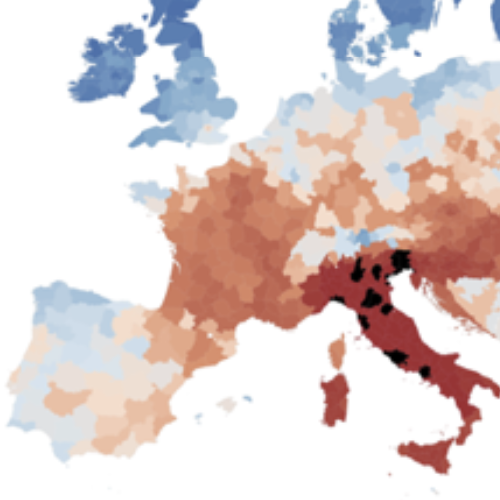
Findings: Median and minimum temperatures, relative humidity, solar radiation, and precipitation emerge as key climatic determinants, while long-range mobility, short-range diffusion, and national borders structure spatial spread. Projections indicate that the proportion of the European population exposed to Aedes albopictus could rise from 49% today to over 90% by 2049 under multiple climate scenarios. Country-level analyses identify four distinct risk trajectories of Aedes albopictus presence: already fully at risk, with increasing risk, persistently low-risk, and currently uninvaded but projected to face rising risk.
Interpretation: The identification of different national risk trajectories provide actionable guidance for surveillance, vector control, and public health preparedness. This framework delivers openly accessible projections of Aedes albopictus presence which provide a basis for future studies assessing potential arboviral risk under multiple climate scenarios.
Funding: DURABLE, IBEID, INCEPTION, LEAPS.